Debora Szpilman Illustrates Jancis Robinson’s 50 Years of Wine for the Financial Times
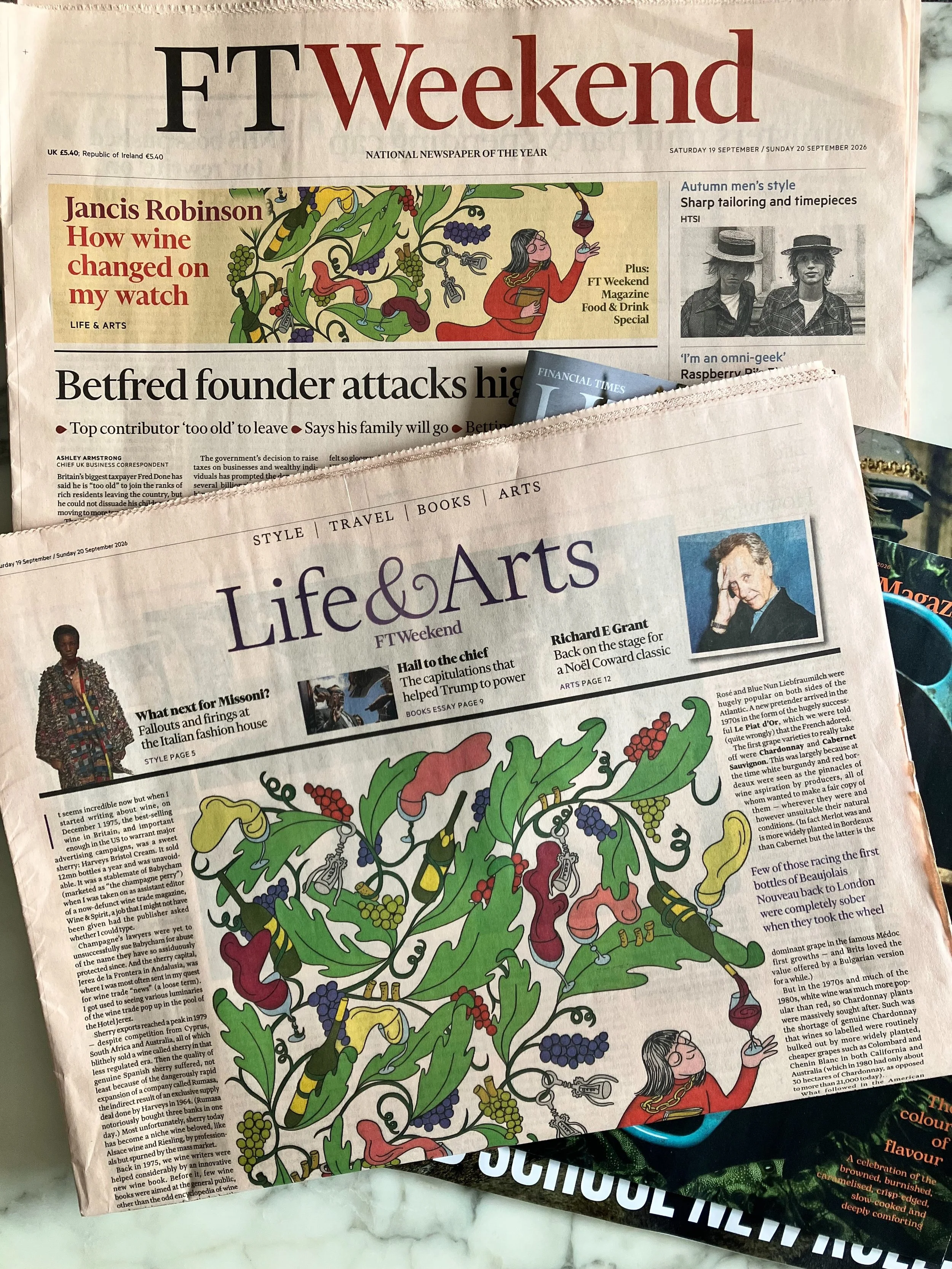
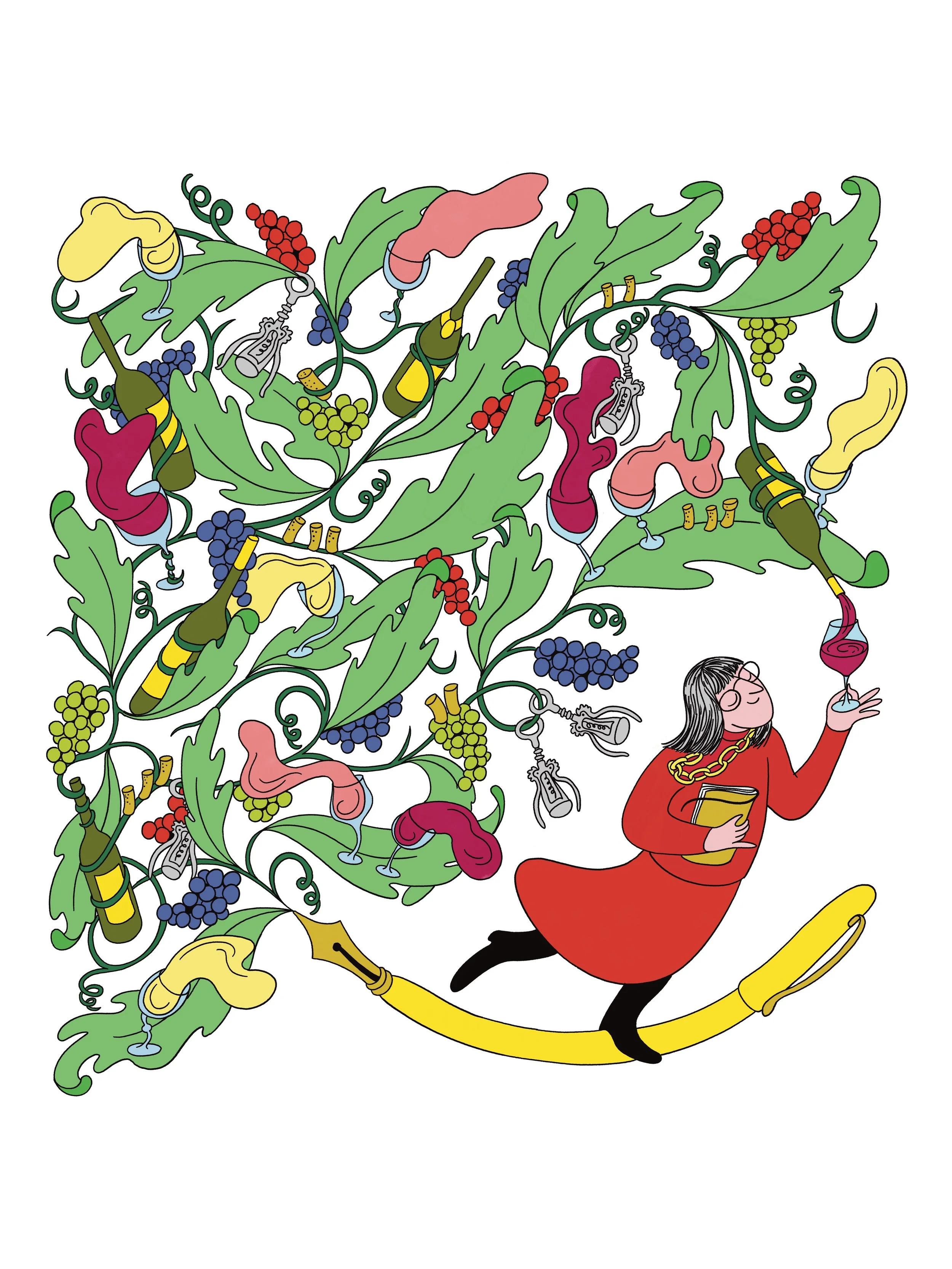
Debora Szpilman has illustrated a landmark Financial Times Weekend feature celebrating Jancis Robinson’s 50 years writing about wine. Published in FT Life & Arts, “I’ve covered wine for 50 years. Here are 50 ways it changed” looks back at half a century that transformed how wine is made, bought, sold, understood and consumed.
The feature also marks another chapter in a long-running visual collaboration between Debora and one of the world’s best-known wine writers.
Brazilian-born, Paris-based illustrator Debora Szpilman has become closely associated with Jancis Robinson’s Financial Times wine writing, regularly translating a subject dense with geography, history, economics and specialist terminology into images with warmth, movement and humour.
For this anniversary edition, Debora’s illustration takes centre stage on the FT Weekend Life & Arts cover, accompanying one of Robinson’s most personal surveys of the wine world to date.
Jancis Robinson: 50 years of writing about wine
Robinson began professionally writing about wine on 1 December 1975, joining the trade publication Wine & Spirit. Fifty years later, the landscape she describes in her Financial Times anniversary essay is almost unrecognisable.
When Robinson started, Harveys Bristol Cream was selling around 12 million bottles a year, supermarket wine buying was in its infancy and much of the wine-drinking public still relied on specialist merchants.
Today the conversation encompasses natural wine, direct-to-consumer sales, regenerative viticulture, climate change, wine tourism, celebrity rosé and an increasingly global map of wine production.
It makes the feature much more than a retrospective. Through 50 individual observations, Robinson charts how an apparently traditional industry repeatedly reinvented itself.
From Babycham and Blue Nun to natural wine and regenerative vineyards
The scale of that transformation gives Debora an unusually rich piece of editorial material to work with.
Robinson moves from the mass-market wines of the 1970s — Harveys Bristol Cream, Mateus Rosé and Blue Nun — through the growth of Chardonnay and Cabernet Sauvignon, the Beaujolais Nouveau phenomenon, American wine culture, Australian Shiraz and the rise of wine scores.
She also examines developments that have fundamentally changed the structure of the industry: supermarket retailing, wine auctions, counterfeiting, direct-to-consumer sales, global wine tourism and the gradual erosion of the old distinction between so-called Old World and New World wine.
The story eventually arrives at some of the questions shaping wine today: biodiversity, soil health, organic production, regenerative viticulture, lightweight bottles and the consequences of climate change for vineyards around the world.
The result is effectively a compressed cultural history of wine from 1975 to 2026.
Illustrating the world of wine
Debora’s relationship with the subject is itself becoming substantial.
She is a regular contributor to the Financial Times and describes herself as a weekly illustrator for Robinson’s wine column. Her previous drawings have tackled everything from Bordeaux and Burgundy to restaurant wine prices, Australian Shiraz, climate change and emerging wine regions.
Rather than literally illustrating bottles, grapes and vineyards, Debora often approaches wine through the behaviour and personalities surrounding it.
That makes her work particularly suited to Robinson’s writing. Wine might be the subject, but the stories are frequently about economics, culture, travel, taste, status, agriculture, memory and people.
Debora reduces those complicated ideas into deceptively simple visual observations.
Her loose line, elegant figures and sense of movement give the drawings an immediacy that feels very different from the traditional visual language of wine publishing. There is sophistication without reverence — an important distinction for a subject that can easily become intimidating.
Who is Debora Szpilman?
Debora Szpilman is a Brazilian illustrator who has lived in Paris since 2013.
Before becoming a full-time illustrator, she studied architecture at UFRJ in Rio de Janeiro and fashion at Studio Berçot in Paris, subsequently working as a design assistant for Azzedine Alaïa. Her illustration practice has since developed around three recurring ingredients: movement, humour and poetry.
Her clients have included the Financial Times, The New Yorker, The New York Times, The Paris Review, Bloomberg Businessweek, The Washington Post, The Wall Street Journal, The Atlantic, Food & Wine and Airbnb.
That background across architecture, fashion and observational drawing perhaps explains why her editorial work feels simultaneously structured and spontaneous.
Why Debora Szpilman and Jancis Robinson work so well together
There is an interesting contrast at the heart of the collaboration.
Robinson’s writing is built on extraordinary depth of knowledge. She became the first person outside the wine trade to pass the Master of Wine examinations in 1984, has written for the Financial Times since 1989 and is closely associated with reference works including The Oxford Companion to Wine and, with Hugh Johnson, The World Atlas of Wine.
Debora responds to that density by doing almost the opposite visually.
She simplifies.
A gesture, a character, an expression or a visual joke can open the subject to somebody who may know nothing about Burgundy vintages or biodynamic viticulture.
It is a good example of what editorial illustration can do at its best: not decorate an article, but provide another route into it.
A changing map of wine
One of the most interesting threads running through Robinson’s 50-year retrospective is geography.
When Hugh Johnson first published The World Atlas of Wine in 1971, Robinson notes that France received 74 pages while South America received only two and New Zealand just seven words.
Robinson is now preparing the ninth edition of the atlas with dramatically different priorities. Wine production has expanded into regions that would barely have appeared on the international wine map when she began writing.
Climate change is accelerating that shift further, moving viable wine production towards cooler latitudes while exposing established vineyards to drought, wildfire, frost, hail and flooding. Harvests are now occurring around two weeks earlier on average than they once did, according to Robinson’s FT account.
The history of wine, in other words, is increasingly a history of environmental change too.
Fifty years of wine, distilled into one FT Weekend package
That breadth is what makes this particular commission significant.
The Financial Times package connects 50 years of wine journalism, one of the subject’s most influential writers and an illustrator who has spent several years developing a distinctive visual language around contemporary wine culture.
For Debora, the Life & Arts cover feels like a natural culmination of that relationship — moving from the weekly rhythm of Robinson’s column to an anniversary feature that takes stock of the entire period.
And despite the enormous amount that has changed since 1975, Debora’s approach remains refreshingly human.
Wine can involve terroir, economics, geology, agriculture, climate science, luxury, branding and centuries of tradition.
Sometimes the best way into all of it is still simply a very good drawing.