Jon Gray / GRAY318 Designs Dostoevsky Book Covers for Mondadori Oscar Classici
British book designer Jon Gray, known professionally as GRAY318, has designed a series of new covers for Fëdor Dostoevsky’s books for Italian publisher Mondadori and its Oscar Classici collection. Art direction is by Cecilia Flegenheimer. The series brings a single graphic identity to some of Dostoevsky’s most important novels and shorter works, including Crime and Punishment, The Brothers Karamazov, Demons, White Nights and The Gambler.
Dostoevsky Series — Project Information
Book cover designer: Jon Gray / GRAY318
Author: Fëdor Dostoevsky / Fëdor Dostoevskij
Publisher: Mondadori
Collection: Oscar Classici
Art Director: Cecilia Flegenheimer
Country: Italy
Who designed the Mondadori Dostoevsky book covers?
The Mondadori Oscar Classici Dostoevsky covers were designed by British graphic designer Jon Gray, also known as GRAY318, with art direction by Cecilia Flegenheimer.
Gray creates a consistent visual language across the collection using monochrome nineteenth-century figures, greatly extended black silhouettes, cream backgrounds, oversized vertical FËDOR DOSTOEVSKIJ typography and individual accent colours.
Small objects distinguish one story from another: an axe appears on Crime and Punishment, dice on The Gambler, flowers on White Nights and a decorative fan on The Eternal Husband. Rather than illustrating every story literally, the covers turn recurring ideas in Dostoevsky — identity, violence, obsession, guilt, social status and psychological tension — into a graphic system.
It is a useful example of book series design: each cover has its own character, but the books become even stronger when viewed together.
Which Dostoevsky books are in the GRAY318 Mondadori series?
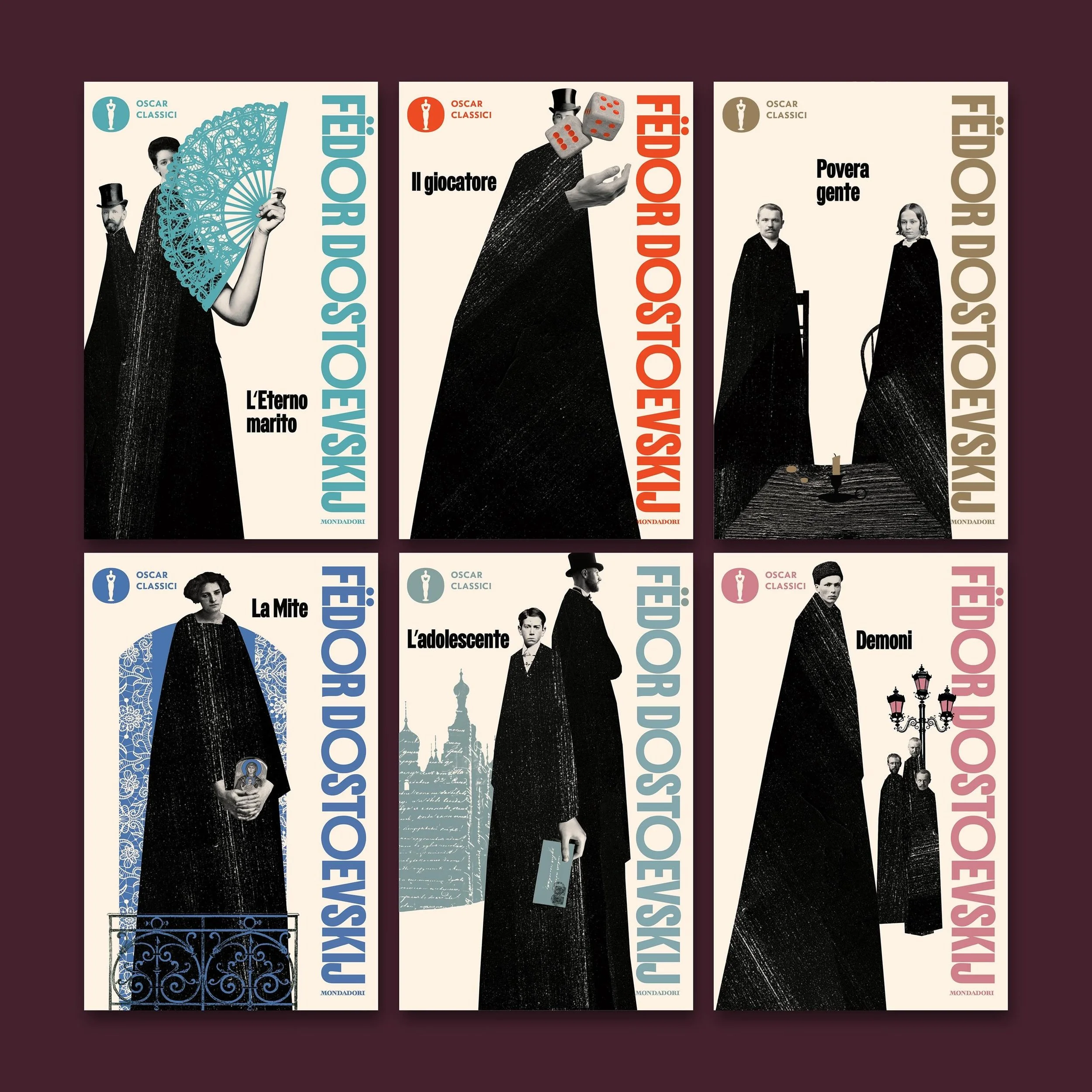
The covers shown in the series include:
I fratelli Karamazov — The Brothers Karamazov
Le notti bianche — White Nights
Delitto e castigo — Crime and Punishment
L’eterno marito — The Eternal Husband
Il giocatore — The Gambler
Povera gente — Poor Folk
La mite — The Meek One
L’adolescente — The Adolescent / A Raw Youth
Demoni — Demons
These titles span much of Dostoevsky’s career, from the early Poor Folk to his final novel, The Brothers Karamazov. Dostoevsky remains particularly well represented within Mondadori’s Oscar Classici catalogue, which also includes titles such as Notes from Underground, The Idiot and The Double.
The stories behind the Dostoevsky covers
I fratelli Karamazov — The Brothers Karamazov
Dostoevsky’s final novel centres on the chaotic Karamazov family and the murder of its father, Fyodor Pavlovich. Brothers Dmitri, Ivan and Alyosha represent radically different responses to faith, reason, desire and morality.
Part family drama, part murder mystery and part philosophical argument, The Brothers Karamazov asks one of Dostoevsky’s central questions: how responsible are we for the actions of other people?
Le notti bianche — White Nights
White Nights follows a lonely dreamer wandering through St Petersburg who meets a young woman called Nastenka.
Over a series of summer nights, companionship develops into romantic hope. It is one of Dostoevsky’s most accessible and tender stories: a short work about loneliness, imagination, unrequited love and the sometimes painful distance between the life we imagine and the one we actually live.
Delitto e castigo — Crime and Punishment
One of the most famous psychological novels ever written, Crime and Punishment follows impoverished student Rodion Raskolnikov, who murders an elderly pawnbroker after convincing himself that exceptional people may have the right to transcend ordinary morality.
The crime itself happens relatively early. Dostoevsky is more interested in what follows: paranoia, guilt, rationalisation and Raskolnikov’s encounters with investigator Porfiry Petrovich and Sonya Marmeladova.
The axe in GRAY318’s cover design immediately reduces this enormous novel to one disturbing object.
L’eterno marito — The Eternal Husband
In The Eternal Husband, Pavel Pavlovich Trusotsky confronts Velchaninov, a man who previously had an affair with his wife.
Their meeting develops into a strange psychological duel involving betrayal, masculinity, jealousy and revenge. As with much of Dostoevsky, neither man can easily be reduced to victim or villain.
Il giocatore — The Gambler
The Gambler follows Alexei Ivanovich, a young tutor living among wealthy Russians at a European resort, whose increasing obsession with roulette becomes entangled with his intense relationship with Polina.
Dostoevsky knew gambling addiction personally. The resulting novel captures the extraordinary combination of hope, irrationality, humiliation and exhilaration created by the possibility of winning everything — or losing everything — in seconds.
Povera gente — Poor Folk
Published in 1846, Poor Folk was Dostoevsky’s first novel.
Told through correspondence between impoverished government clerk Makar Devushkin and Varvara Dobroselova, it examines poverty, dignity and the emotional lives of people occupying the margins of nineteenth-century St Petersburg.
The book announced many of the concerns that would continue throughout Dostoevsky’s writing: social inequality, humiliation, compassion and the complexity of apparently ordinary lives.
La mite — The Meek One
The Meek One is a dark psychological story narrated by a pawnbroker following the death of his young wife.
As he attempts to reconstruct their relationship, his monologue gradually exposes possessiveness, pride and emotional cruelty. Dostoevsky turns one man's attempt to explain what happened into a study of how difficult genuine self-understanding can be.
L’adolescente — The Adolescent
Also translated into English as A Raw Youth, The Adolescent follows young Arkady Dolgoruky as he arrives in St Petersburg determined to establish his independence.
Ambition, money, family secrets and his difficult relationship with his biological father pull Arkady into an increasingly complicated adult world. The novel examines the formation of identity and what happens when youthful ideals collide with reality.
Demoni — Demons
Demons — also translated as The Devils or The Possessed — takes political radicalism as the starting point for a much wider examination of ideology, manipulation and moral responsibility.
A revolutionary group forms in a provincial Russian town, but Dostoevsky is interested less in political theory than in what happens when powerful ideas encounter flawed human personalities.
More than 150 years later, the novel remains strikingly relevant to discussions about extremism, charismatic influence and ideological certainty.
About Jon Gray / GRAY318
Jon Gray is a British graphic designer and internationally recognised book cover designer who works under the name GRAY318.
Gray has designed jackets for major publishers internationally and has created covers for writers including Zadie Smith, Sally Rooney, David Foster Wallace, Jonathan Safran Foer and Salman Rushdie. His portfolio also includes influential designs for books such as Infinite Jest, Everything Is Illuminated and George Orwell’s 1984.
His work has been recognised by AIGA in New York and D&AD in the UK, and he is a co-founder of the Academy of British Cover Design.
The Dostoevsky project demonstrates one of the particular challenges of literary cover design: finding a contemporary visual idea for books that have already appeared in thousands of editions.
Rather than treating each title as an unrelated commission, GRAY318 makes Dostoevsky himself the identity of the collection.
About Mondadori and Oscar Classici
Mondadori is one of Italy’s major book publishers, with Oscar Classici forming part of its extensive paperback programme devoted to classic literature.
The current Oscar Classici catalogue includes works by writers ranging from Dostoevsky and Tolstoy to Jane Austen, Oscar Wilde, Dante, Bram Stoker and Alexandre Dumas. Dostoevsky is particularly prominent within the collection, with numerous novels and shorter works available in Italian editions.
For a publisher repeatedly presenting canonical literature to new generations of readers, cover design becomes more than decoration. It gives familiar books a new point of entry.
GRAY318’s Dostoevsky covers do exactly that: one author, nine very different stories and a graphic identity capable of making the entire collection immediately recognisable.