Illustrated Clouds: Christian Montenegro’s Vida y obra de algunas nubes
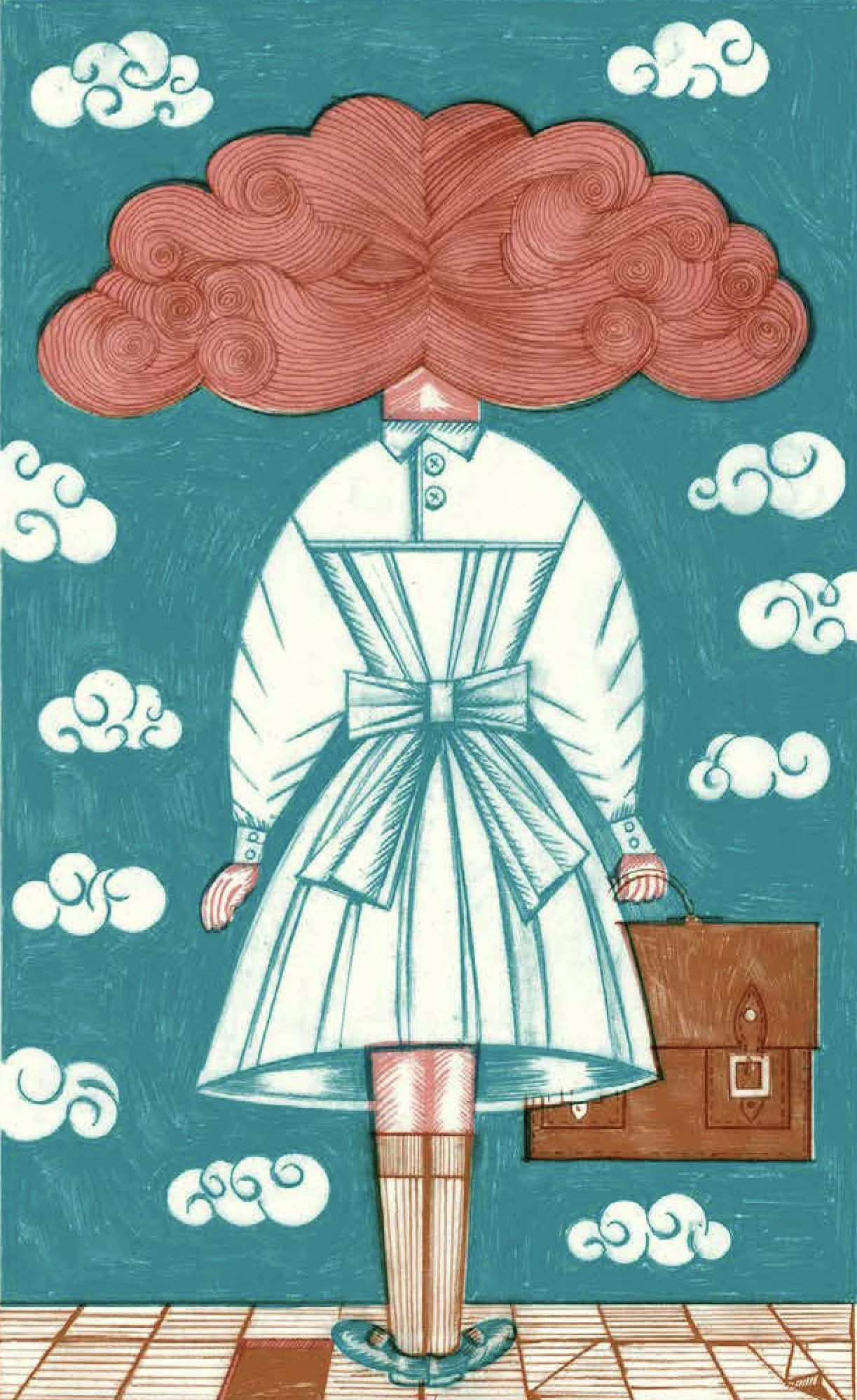
In Vida y obra de algunas nubes, Argentinian illustrator Christian Montenegro and writer Hernán Ronsino create a wonderfully strange collection of cloud stories.
From a polar-bear cloud appearing over Alaska to a pirate attempting to capture a cumulonimbus.
Published by Editorial Limonero, the book treats clouds as animals, myths, coincidences, scientific puzzles and characters with lives of their own.
Ronsino’s miniature stories move continually between history and invention, while Christian responds with a distinctive body of hand-drawn, three-colour illustrations.
For anyone searching for illustrated clouds, cloud illustration inspiration, surreal cloud drawings or artists who draw clouds, Vida y obra de algunas nubes is an unusually imaginative exploration of what a cloud can become.
Christian Montenegro returns to hand-drawn illustration
I’ve watched Christian’s work develop over many years, so seeing him return so emphatically to pencil, drawing and stencils, rather than primarily Illustrator and Photoshop, feels almost like cleansing the palate after all these years.
What makes it particularly exciting is that Christian brings all the visual knowledge accumulated through years of commissioned illustration, design, composition and digital image-making back into the physical act of drawing.
The images feel knowledgeable without being overworked and controlled without losing spontaneity and there’s a renewed energy. The sense of an experienced illustrator becoming excited by his own image-making again.
And clouds give Christian the perfect subject with which to do it.
Explore more of Christian’s illustration work at Dutch Uncle and Christian’s own portfolio.
The cloud stories in Vida y obra de algunas nubes
Ronsino approaches each cloud almost as if it has acquired its own fragment of folklore.
The stories travel around the world and backwards and forwards through invented history. Some take only a paragraph to unfold; others contain characters, correspondence and miniature narratives.
Together they read like an eccentric archive of atmospheric events that somebody might just conceivably have forgotten to record.
Aristófanes and the horse clouds
The book opens with a man named Aristófanes running from a dangerous storm.
As he escapes, he notices two clouds, each with the precise form of a horse. The wind makes them appear to gallop through the sky.
To anybody else they might simply be storm clouds. To Aristófanes they are beautiful horses running through the heavens.
Christian fills the accompanying image with enormous curling masses in which horse, cloud and wind begin to merge into one another.
It establishes one of the central ideas of the book immediately: clouds become something else because somebody has looked at them and imagined it.
Aristófanes and the horse clouds
The polar-bear cloud over Alaska
The polar-bear cloud over Alaska
In the winter of 1675, a cloud shaped exactly like a polar bear supposedly formed above Alaska.
Its appearance lasted barely five seconds before disappearing at dusk.
Nobody was there to see it.
Ronsino then imagines what might have happened had a real polar bear looked upwards at precisely that moment: perhaps, seeing itself reflected in the sky, it would briefly have believed that the entire world was a mirror.
Christian illustrates the event almost sequentially. Small white forms gradually coalesce into the recognisable silhouette of a polar bear before dissolving again.
It is a beautiful expression of the book’s underlying idea: a cloud can become an image for only the instant in which someone recognises it.
The fisherman with a cloud for a hat
Every day a fisherman returns to the harbour at Santa Coloma at exactly the same time that a cloud forms over the coast.
As he unloads his catch, perspective makes the cloud appear to sit directly on his head like an enormous hat.
Children begin waiting for the fisherman and his cloud-hat each day. Their teacher, Señorita Petrecca, secretly draws him while the class works.
Later she encounters him away from the harbour. This time he is smartly dressed and wearing a real top hat. Petrecca gives him her drawing; the fisherman is touched, and she realises that she may be beginning to fall in love with him.
The cloud begins as a visual coincidence but becomes part of a completely human story.
The fisherman with a cloud for a hat
Doctor Song and Señora Nube García
Doctor Song and Señora Nube García
One of the book’s stories develops through a correspondence between Señora Nube García and Doctor Song.
Nube García complains about a mysterious galloping noise disturbing her apartment. Doctor Song responds with increasingly elaborate advice, and their exchange reappears at intervals throughout the book.
Christian returns each time to the same cutaway view of the building, allowing small visual changes to accumulate as the correspondence develops.
It gives Vida y obra de algunas nubes another kind of cloud story: here even a woman’s name allows the idea of the cloud to slip into an absurd everyday situation.
The village that has never seen the sun
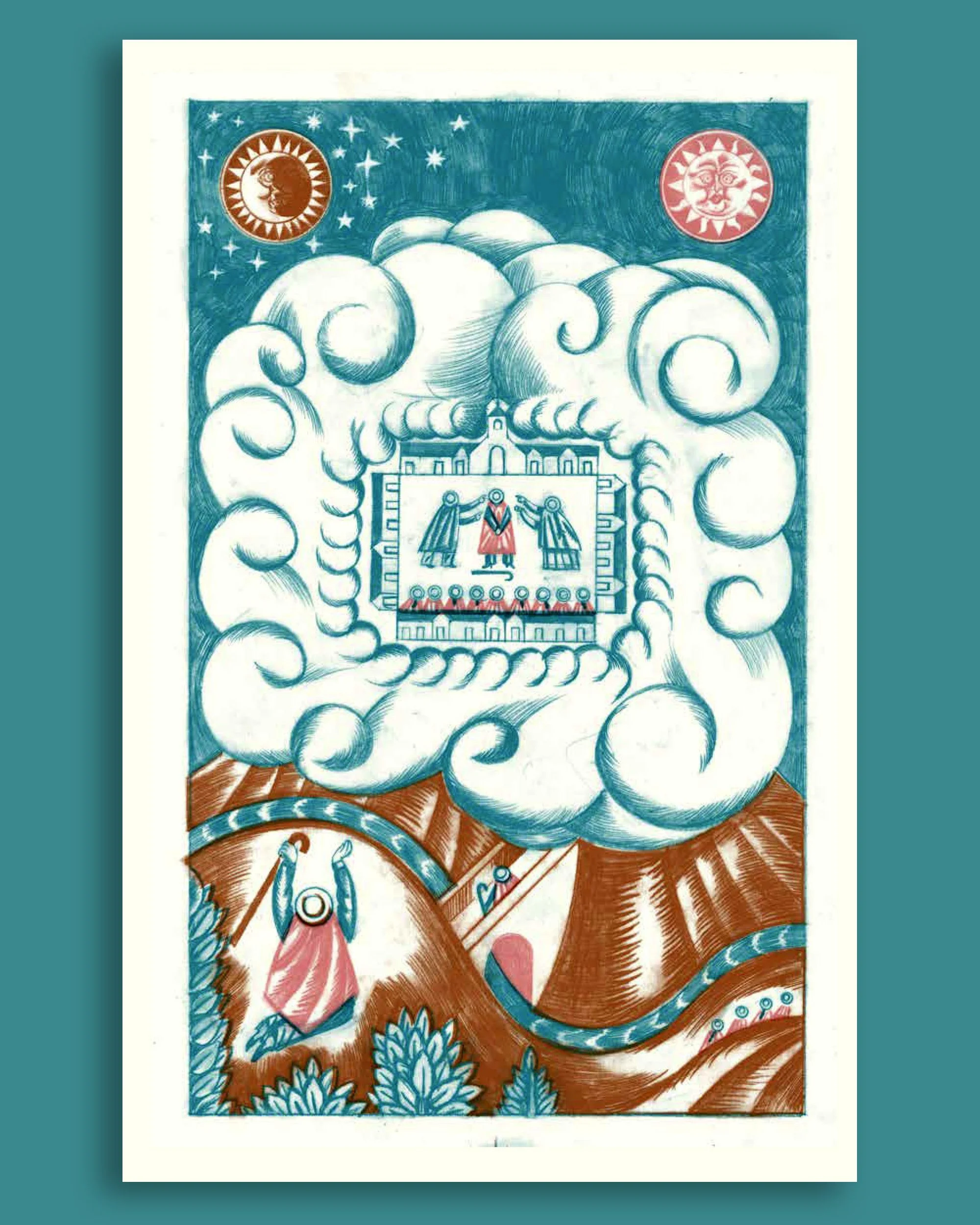
In the Andean village of Xaljá, a cloud permanently occupies the sky.
Its inhabitants have never seen the sun. They grow up knowing only cloud, rain, snow and grey light and are warned that anyone attempting to cross the bridge through the fog may be blinded.
A young shepherd named Abel eventually crosses the boundary at night while looking for lost animals.
For the first time he sees the stars and the moon and, when morning arrives, a blue sky.
He returns to tell the village what lies beyond the cloud. His story frightens some people and fascinates others. Eventually the younger inhabitants begin secretly leaving at night to search for the sun themselves.
Christian contains the settlement within a great swirling cloud, turning an atmospheric condition into both geography and psychological boundary.
The village that has never seen the sun
The travelling clouds of Malaysia
The travelling clouds of Malaysia
In Malaysia, Ronsino invents the legend of the nubes pasajeras — travelling clouds.
Because clouds move continually from place to place, people say that when they release showers of rain they are actually recounting the stories of their journeys.
Rain becomes a form of storytelling.
A cloud passing overhead therefore carries traces of all the landscapes, people and places it has already crossed.
It is one of the simplest stories in the book but perhaps one of the best descriptions of its larger idea: clouds are travellers carrying stories across the world.
The mysterious Buh — or Buih — cloud
Another cloud apparently appears twice, separated by decades and thousands of miles.
The first sighting occurs in Porto in 1926, when a boy walking to school is surrounded by a creeping mist that twists around him almost like a serpent.
As it closes in, he believes he hears the cloud say something resembling “Buh!”
Then it disappears.
A remarkably similar event takes place years later in Valparaíso, where a girl walking home is surrounded by the same snake-like cloud. This time she hears something more like “Buih!” before the cloud disappears over the sea.
Ronsino gives the absurd encounter the specificity of a documented historical incident, which makes it both funny and oddly unsettling.
The mysterious Buh — or Buih — cloud
The cloud that steals a church bell
The cloud that steals a church bell
Inspector Marchetti is investigating a sequence of unexplained thefts in a small Italian village.
Ropes disappear. Bicycles vanish. Ladders go missing.
Marchetti questions so many inhabitants that eventually the villagers begin wondering whether perhaps the inspector himself is responsible.
Then Marchetti notices an unusually long, thin cloud moving above the village. One end resembles a hook.
The cloud passes over the church and envelops its cupola.
When it moves away, the bell has disappeared.
The impossible suddenly acquires its own peculiar logic: the cloud has been stealing things.
It is exactly the kind of visual proposition Christian handles so well — taking something completely absurd and drawing it convincingly enough that, for a moment, it seems perfectly reasonable.
The laughing cloud of the Amazon
PDF page 11
In a village in the Amazon, local legend tells of a cloud that laughs before releasing an enormous rainfall.
The noise is not thunder.
It is laughter.
And its arrival is welcomed rather than feared because the cloud is believed to announce a period of abundance and happiness.
Christian transforms it into something halfway between a cloud, creature, ceremonial mask and spirit.
The story shows how easily Ronsino moves between meteorology and mythology. A cloud can simultaneously be weather and a living presence.
The laughing cloud of the Amazon
The smallest cloud ever recorded
The smallest cloud ever recorded
In 1907, an international congress is supposedly convened in Oslo to establish the identity of the smallest cloud in history.
Scientists arrive with competing examples from around the world.
But a young Mexican scientist, Marita Perkins, possesses evidence that radically changes the competition: an ancient record from Oaxaca showing an extraordinarily tiny cloud.
Christian’s response is wonderfully economical.
Instead of illustrating an enormous sky, he places an almost absurdly small turquoise mark between two huge hands.
The entire illustration becomes a joke about scale.
A poem made from the word “cloud”
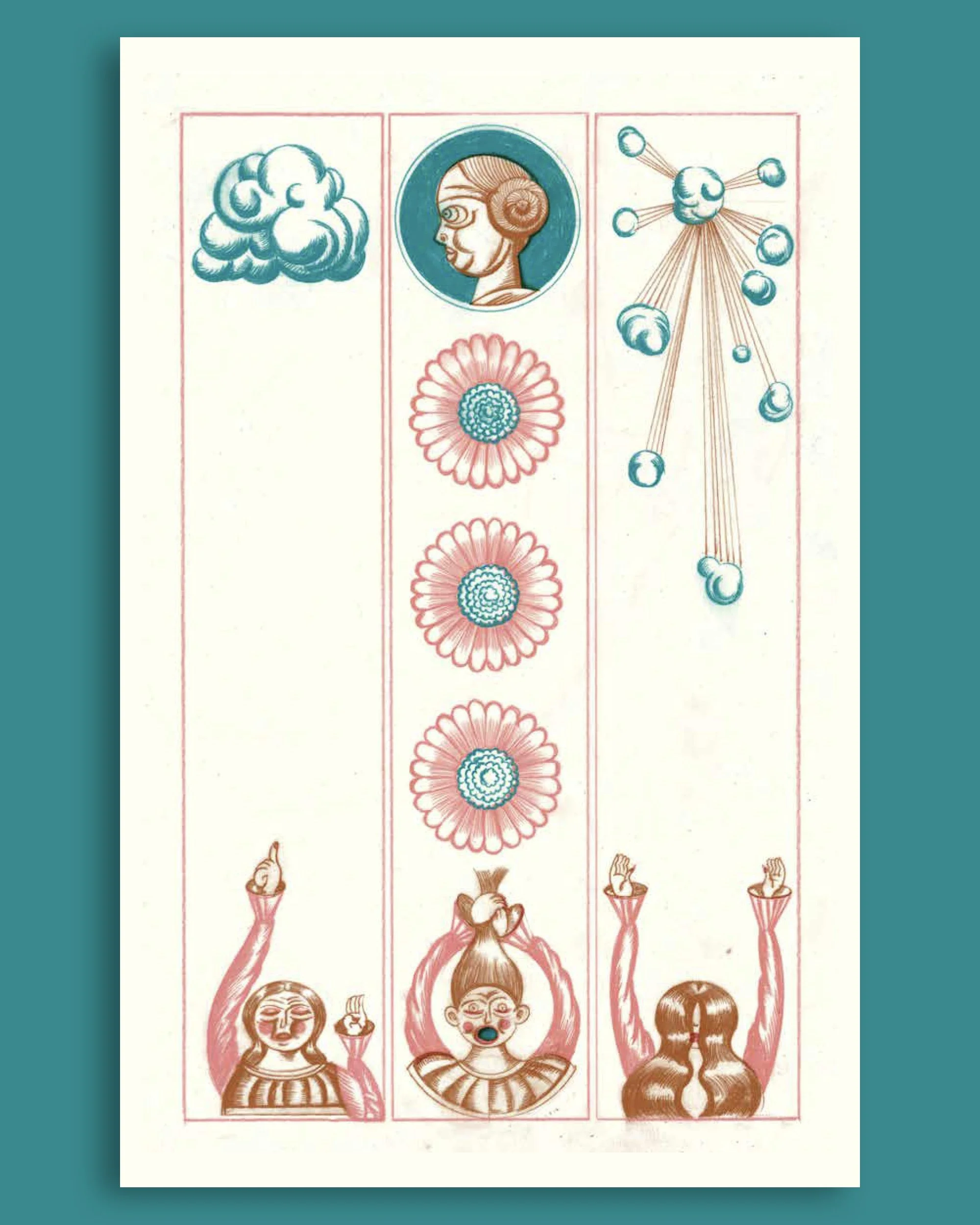
Ronsino introduces a Spanish poet who discovers that poems can apparently be released from the word nube — cloud itself.
Rather than treating the cloud only as an object in the sky, the story turns the word into material: something that can be dismantled, rearranged and transformed.
Christian responds with a vertical, almost diagrammatic composition in which cloud symbols, portraiture and decorative forms are organised like pieces of a visual code.
It extends the idea of clouds beyond weather altogether. A cloud can be a shape, a story or even a word waiting to be rearranged.
A poem made from the word “cloud”
The clouds that become night
The clouds that become night
One of the shortest stories describes a tradition in India.
Grandparents tell their grandchildren that when night arrives, clouds transform themselves into darkness in order to protect people while they sleep.
Christian answers with a page almost consumed by dense brown swirling forms.
The clouds haven’t disappeared.
They have simply become night.
The pirate who tries to capture a cumulonimbus
Pirate Foster dreams of catching the great white whale, inspired by the legend of Captain Ahab.
He assembles a crew and spends years pursuing his quarry.
Then one morning an enormous white form appears on the horizon.
But it isn’t a whale.
It is a vast cumulonimbus cloud.
Foster decides to pursue it anyway.
His crew thinks he has lost his mind. How can anyone capture a cloud?
After hours of attempting the impossible, Foster eventually opens the beer barrels and proposes a toast to their effort to catch something that cannot be caught.
The story could almost act as a metaphor for the entire book.
Illustrating clouds is itself an attempt to give permanent form to something whose defining characteristic is continual change.
The pirate who tries to capture a cumulonimbus
The world’s only cloud caresser
The world’s only cloud caresser
Everybody knows the skyscrapers of New York, Ronsino tells us, but few people know about the world’s only acaricianubes — cloud caresser.
It supposedly stands in Tintina, Santiago del Estero.
The twelve-storey building has padded antennae extending from its roof. When clouds pass overhead, the antennae gently brush against them.
The clouds shiver as though they are being tickled.
It is a lovely reversal of the skyscraper. Instead of an architecture designed simply to reach the sky, this building has been constructed specifically to touch clouds.
The girl with her head in the clouds
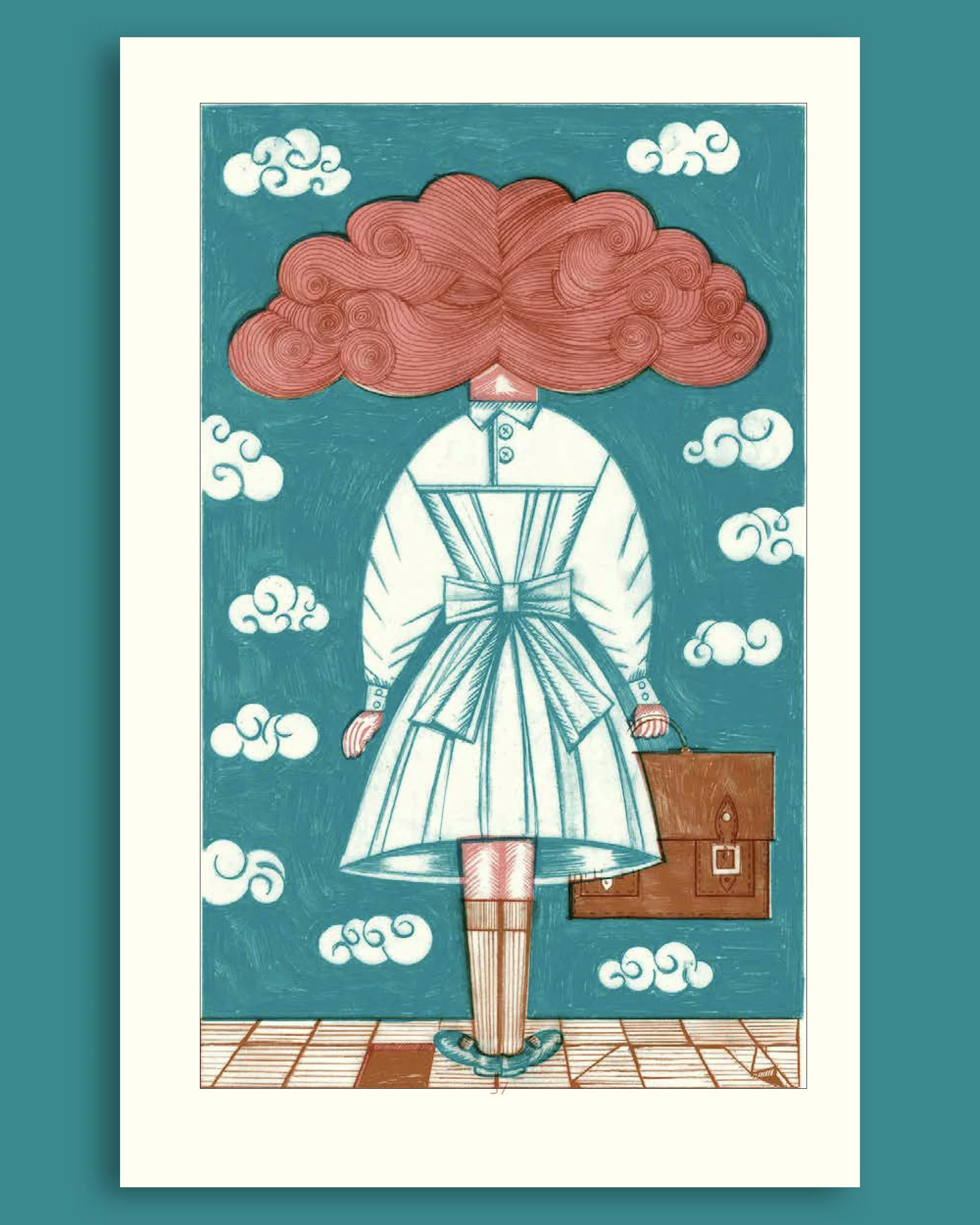
Ronsino takes the familiar expression “to have your head in the clouds” and makes it literal.
Lucy encounters a girl at school whose head appears to have become enveloped by an enormous cloud.
The phrase stops being metaphorical and becomes a visual event.
Christian’s illustration makes the transformation wonderfully matter-of-fact: a carefully dressed schoolgirl stands upright while a huge coral cloud occupies the space where her head should be, surrounded by smaller cloud forms.
It is one of the clearest examples in the book of language generating an image.
The girl with her head in the clouds
The stranded cloud in Gambia
The stranded cloud in Gambia
On 25 July 1975, the Tursy brothers supposedly notice a small cloud that appears to have become stranded beside the Nieri Ko river in Gambia.
It remains there.
The brothers decide to trace the exact position of the cloud on the ground and then follow its route as it slowly moves across the landscape.
For months they travel after it, crossing fields, villages and rivers.
Eventually the cloud dissolves.
According to Ronsino’s story, the journey becomes commemorated through a ritual in which people retrace the route, plant a laurel, eat together and bathe in the river.
Something completely temporary has produced something permanent: a human tradition created by the movement of a cloud.
The cloud that completes a painting
In 1536, the painter Michelángelo Spataro is attempting to finish a portrait of the King of Spain.
Something about the king’s face is wrong, but Spataro cannot understand what the painting needs.
He wanders through the city looking for an answer until he reaches the harbour.
There, alone in the sky, he sees a cloud shaped like a missing piece of a puzzle.
Suddenly he understands the final line required to complete his portrait.
The cloud becomes an instrument for seeing.
The answer was somewhere above him; Spataro simply had to recognise it.
The cloud that completes a painting
When birds become a cloud
When birds become a cloud
PDF page 22
In a Moldavian village, an enormous flock of birds gathers in the sky each evening.
Together the birds form such a dense shape that meteorologists repeatedly mistake them for a storm cloud.
Christian turns thousands of tiny birds into a huge circular mass suspended above the landscape.
Close up, we see individual birds.
From a distance, we see a cloud.
That shift between individual marks and one larger image also feels particularly appropriate to Christian’s return to physical drawing.
Photographing something that cannot stay still
PDF page 23
Near the end of the book, Ronsino introduces Emma Porter.
After losing her dog in the streets of Montevideo, Emma begins photographing clouds.
Her motivation contains something of the whole book’s philosophy: she wants to make still, if only for an instant, something that itself lasts only an instant.
Christian illustrates a tiny figure isolated inside a huge expanse of the turquoise shadow of a dog.
Photographing something that cannot stay still
An illustrated book about looking upwards
At its heart, Vida y obra de algunas nubes is about looking.
Ronsino takes one of the most ordinary things in our field of vision and repeatedly asks us to reconsider it.
Christian does the same through drawing.
And perhaps that is why his return to pencil and stencil feels so appropriate for this particular book. Clouds demand curiosity. Their forms change before we can completely understand them.
Christian brings years of experience to these drawings without allowing that experience to remove the possibility of discovery.
The result feels unlike anybody else’s illustration I’ve seen: informed by an enormous amount of visual knowledge but still propelled by the excitement of wondering what else this mark, shape or cloud might become.
Vida y obra de algunas nubes ultimately turns the sky into a collection of stories.
You just have to remember to look up.
Explore more Christian Montenegro illustration at Dutch Uncle and visit Christian’s portfolio.
Book details
Title: Vida y obra de algunas nubes
English translation: Life and Work of Some Clouds
Writer: Hernán Ronsino
Illustrator: Christian Montenegro
Publisher: Editorial Limonero
Subject: Illustrated clouds, imaginary histories, folklore and storytelling
Illustration style: Hand-drawn, graphic, limited-colour and surreal