Noma Bar Illustrates Early Fiction by Margaret Atwood for Vintage Classics
This new Atwood collection stands as a visual and literary monolith in four volumes, Life Before Man, Bodily Harm, Dancing Girls and Other Stories, and Bluebeard’s Egg.
This set represents a pivotal era from the late 1970s into the early 1980s in which Margaret Atwood’s prose operated with calm precision.
She wrote of power, the human body, and the fragile social contracts that inevitably fracture under pressure.
The experience of reading these stories follows a deliberate trajectory. They begin with a veneer of politeness before descending into a calculated awkwardness.
In Atwood’s world, that awkwardness is the point.
The Visual Language of Noma Bar and Suzanne Dean
These Vintage Books editions are a masterclass in synergy between author and artist. Under the creative direction of Suzanne Dean, the covers mirror the internal logic of the writing. They appear deceptively simple. Each hides a problem for the eye to solve.
Noma Bar’s illustrations utilize reduced forms and negative space to create a visual double entendre. Much like Atwood’s sentences, the image contains a hidden truth that reveals itself only after a half second pause.
That specific moment of realization, the beat between seeing and understanding, is purely Atwoodian.
A Study of Four Volumes

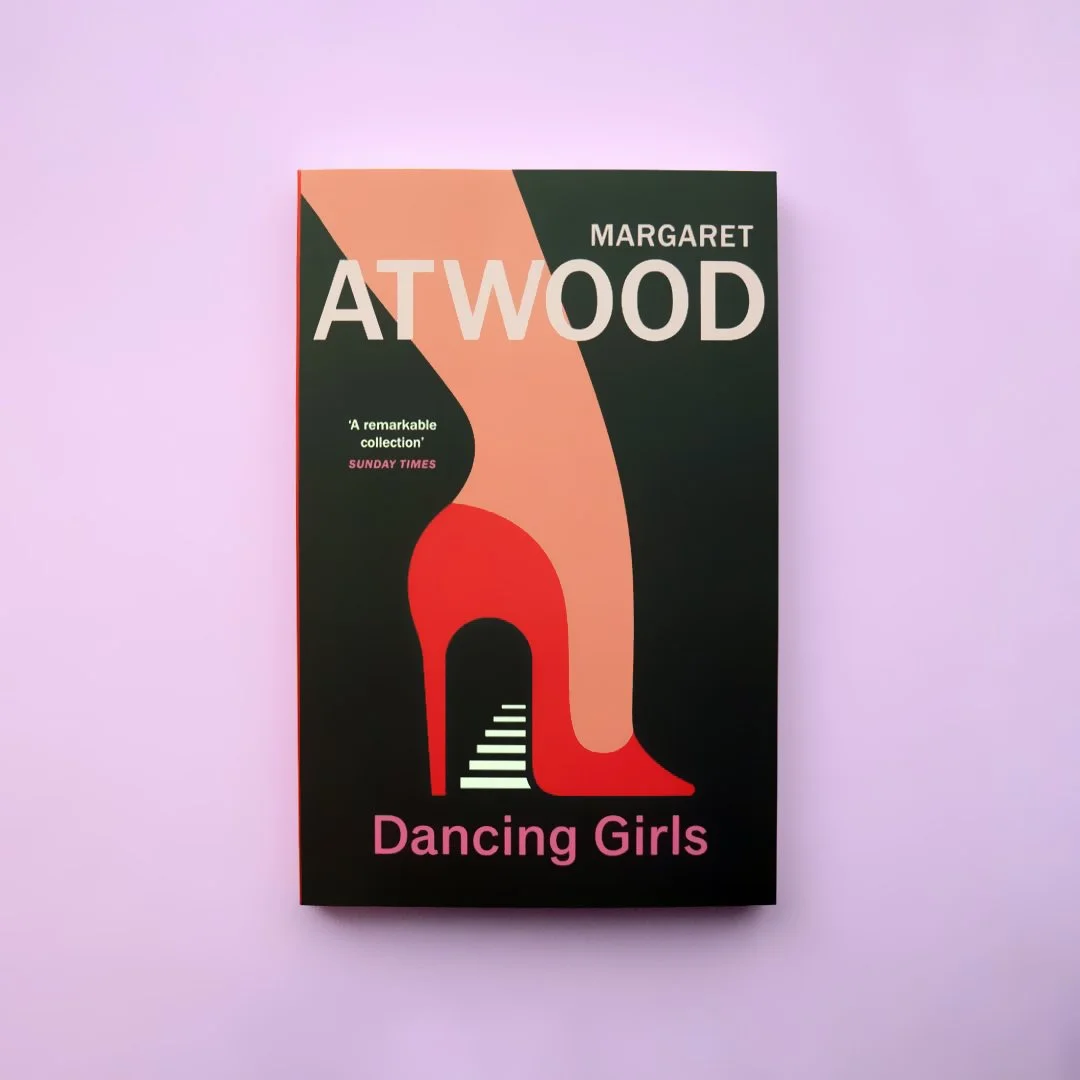


Each title in this red spined series offers a unique lens into the complexities of the human condition:
Life Before Man: A steady and unflinching stare into the mechanics of marriage and the weight of memory.
Bodily Harm: An exploration of political peril and personal denial set against a backdrop of deceptive warmth.
Dancing Girls and Other Stories: A collection focusing on the friction of social interactions within confined or borrowed spaces.
Bluebeard’s Egg: A microscopic examination of domestic life that dissects the mundane until it becomes alien.
The experience of reading these stories follows a deliberate trajectory. They begin with a veneer of politeness before descending into a calculated awkwardness. In Atwood’s world, that awkwardness is the point.
The Visual Language of Noma Bar and Suzanne Dean
These Vintage Books editions are a masterclass in synergy between author and artist. Under the creative direction of Suzanne Dean, the covers mirror the internal logic of the writing. They appear deceptively simple. Each hides a problem for the eye to solve.
Noma Bar’s illustrations utilize reduced forms and negative space to create a visual double entendre. Much like Atwood’s sentences, the image contains a hidden truth that reveals itself only after a half second pause. That specific moment of realization, the beat between seeing and understanding, is purely Atwoodian.
A Study of Four Volumes
Each title in this red spined series offers a unique lens into the complexities of the human condition:
Life Before Man: A steady and unflinching stare into the mechanics of marriage and the weight of memory.
Bodily Harm: An exploration of political peril and personal denial set against a backdrop of deceptive warmth.
Dancing Girls and Other Stories: A collection focusing on the friction of social interactions within confined or borrowed spaces.
Bluebeard’s Egg: A microscopic examination of domestic life that dissects the mundane until it becomes alien.
The Presence of the Object
These books are as compelling as physical objects as they are as literature. When stacked, the uniform red spines create a sense of curated authority. Although these are early works, they possess an unnerving confidence. They carry the energy of someone who remains perfectly calm during an argument. They possess a quiet and unsettling certainty. They already know exactly where the narrative is heading.
These books are as compelling as physical objects as they are as literature. When stacked, the uniform red spines create a sense of curated authority. Although these are early works, they possess an unnerving confidence. They carry the energy of someone who remains perfectly calm during an argument. They possess a quiet and unsettling certainty. They already know exactly where the narrative is heading.
Further reading
Margaret Atwood – https://margaretatwood.ca
Noma Bar – dutchuncle.co.uk/noma-bar
Vintage Classics – https://www.penguin.co.uk/series/VINTAG/vintage-classics.html